Gaelic (Learners) pathway in an early learning and childcare setting
Stornoway Childcare Centre is a setting for Gaelic (Learners) situated in the grounds of Bun-sgoil Steòrnabhaigh - Stornoway Primary School on the Isle of Lewis. The Centre provides early learning and childcare (ELC) for children under the age of three and is registered for 40 children at any one time. At the time of the inspection, most children were aged two to three years of age.
The improvement issue
Gàidhlig is an integral part of the culture and heritage across Comhairle nan Eilean Siar. Every year, there are children attending the setting whose first language is Gàidhlig, as well as learners who are moving on to Gàidhlig Medium settings. Comhairle nan Eilean Siar’s Gàidhlig Language Plan (2023-2028) states “Comhairle nan Eilean Siar should be a fundamentally bilingual community, in which Gàidhlig and English have equal validity as languages of communication”. Staff acknowledged the importance of enhancing language acquisition in both Gàidhlig and English. As a predominately English-speaking staff team, staff recognised the need to develop their own Gàidhlig language skills to support children’s learning and development.
The Centre manager recognised the need to identify ways to support staff learning within core contracted hours and in a supportive environment. Staff were enthusiastic to find ways of integrating Gàidhlig into the setting using a ‘soft touch’ nurturing approach.
What Stornoway Childcare Centre did
The Centre manager and staff worked together to develop a shared vision of what Gàidhlig learning would look like in a predominately English-speaking setting. They identified that learning Gàidhlig alongside the children would be the best approach to help ensure that this was undertaken in a supportive manner.
Staff explored a range of Gàidhlig resources, both printed and online. They selected everyday phrases, songs, rhymes, and fingerplays that were meaningful and relevant to the children. These resources enabled staff and children to learn Gàidhlig together through singing and daily language use.
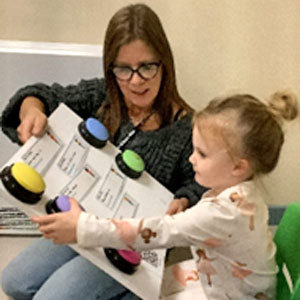
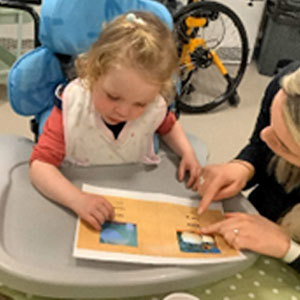
Staff produced an interactive “talking board” with everyday phrases, and an on-line song book developed by Gàidhlig learners. This includes videos with signed communication, words, phonics, and translations. Staff and children use the resources together throughout the day. These are embedded into daily routines and used naturally during activities.
Staff engaged in weekly Gàidhlig classes during non-class contact time. These were delivered in partnership with Community Learning and Development staff and the Early Years Curriculum teacher. During these classes it was identified that some staff needed further support and challenge to help extend their conversational Gàidhlig. To support staff further an image bank was produced to match the topics each week.
Subtle labelling and displays are used throughout key areas within the centre. These visual prompts encourage staff to increase their use of spoken Gàidhlig during daily routines. Talking board topics and associated songs are shared with families using an online platform to support learning at home.
Staff have connected all resources to form a Gàidhlig learner pathway (Crùinn Còmhla le Ionad Cùram-chloinne Steòrnabhaigh). This is used in everyday practice to support staff and children’s learning.
What the sustained impact has been
Staff engagement throughout the development of the Gaelic learner pathway has increased their knowledge and understanding of everyday phrases. As a result, they are more confident communicating with children in Gàidhlig.
Children are exposed to the Gàidhlig language throughout the day, which is evidenced in how they respond to spoken Gàidhlig. For example, the younger children respond through copying signs and responding to song and rhyme prompts. Older children use words, phrases, songs, and rhymes spontaneously throughout the day.
Adopting a ‘soft touch’ nurturing approach allows for testing out language skills in a safe and supportive environment, for both staff and children. Staff feel safe to make mistakes. This supports children to try new words and songs with confidence, knowing that mistakes can lead to learning. This allows children and staff to learn together in a mutually supportive way.
A positive outcome of this project has been an increase in the number of children enrolling into Gàidhlig Medium Education (GME) when moving on in their learning journey. By session 2025/26 the majority of children are learning Gàidhlig. The Gàidhlig learner pathway has been shared with other educational establishments throughout the Comhairle nan Eilean Siar.
Testimonials
“The use of Gàidhlig through songs, rhymes, short phrases and talking boards has had a positive impact on my child’s learning and complements what we are trying to teach him at home. Gàidhlig is an important part of his and our identity and so knowing he has the opportunity to use and hear the language at nursery is very important to us”
(Parent)
“Our daughter will be going to the Gàidhlig nursery next April as I’m a fluent speaker. We have been so pleased that the Stornoway Childcare Centre have been teaching Gàidhlig through talking boards/song and rhymes. It will help massively to her transition from the English to the Gàidhlig. She can count to 10, say/understand basic greetings among other things the staff have been teaching. It’s wonderful to hear her say and sing things in Gàidhlig, she’s even teaching her daddy.”
(Parent)
“The Gàidhlig Songbook that was produced by the staff of Stornoway Childcare Centre has been a fabulous resource and is used daily in our setting and has been since it was shared with us at the start of the year. It has been put together so well using lots of familiar songs with lots of repetition to develop the children's Gàidhlig language. The use of the song book has made a big impact on the children in the Gaelic Learners (GLE) room in my Nursery setting. They use it daily and the children have learnt a lot of the songs from the book, and they have also like to do the Makaton signs when they are singing.
Having observed how well the children responded to the Gàidhlig language, this then spurred the staff in the GLE room to have Gàidhlig as more of a focus, they now use it daily it in routines, group times/activities, displayed around the room a lot more and during play. Some of the children naturally go straight to using the Gàidhlig language when counting and naming colours. One of our Improvement Projects this year is increasing the prominence of Gàidhlig across the Nursery Setting, the Gàidhlig songbook features heavily as part of this project as a resource.”
(Childcare Manager, Sgoil-Àraich an Rubha)
“Having become aware of the Gàidhlig song book through my grandson attending Sgoil-Àraich an Rubha, I was keen to use if for my class that I teach in Sgoil an Rubha. My class engage well with the song book and enjoy taking part in singing the songs and actions.”
(Class Teacher, Sgoil an Rubha)
“The Gàidhlig songbook has had a positive impact on all our Gàidhlig learning staff. It is user-friendly and provides them with the tools they need to pronounce words accurately. It's invaluable to have high-quality resources readily available for all our GME learners.”
(Childcare Manager | Saoghal Beag Nursery- North Uist School)