

Developing an island identity: Strengthening learning through Gàidhlig language, culture and community
See Gaelic version
Bun‑sgoil Bhun Easain (Bunessan Primary School) sits just outside the village of Bunessan on the Isle of Mull, in a remote rural setting. The school has 27 pupils across Gàidhlig Medium Education (GME) and English Medium Education (EME). Gàidhlig Medium Education provision began in 2019.
Almost all primary-age children travel by school transport. The school also has a Pre‑5 Unit with roll of nine where children learn through English, with a Gaelic (Learners) programme. After P7, children move to secondary school on the mainland and board in a hostel during the week.
The improvement issue
Staff wanted to make better use of the rich resources available in the local community and environment. They were also aware of the long‑term challenge of encouraging young people to return to the island after moving away for secondary education.
The school’s strong Gàidhlig heritage was important to the school and a key priority, and staff aimed to create a learning experience that celebrated language, culture and the uniqueness of island life.
What Bun‑sgoil Bhun Easain did
Leadership and vision
Staff used their strong understanding of the local context to guide change. They refreshed the school vision with strong involvement from children:
“Creating confident learners in a caring and creative community —
A’ cruthachadh luchd‑ionnsachaidh misneachail ann an coimhearsnachd coibhneil agus chruthachail.”
This shared vision shaped planning, learning and partnership work.
Learning, teaching and assessment
Staff focused on improving writing, developing play‑based and inquiry‑based approaches, and strengthening children’s problem‑solving skills. Teachers set high expectations, used effective questioning, and differentiated learning appropriately.
Outdoor learning, digital technology and real‑life contexts were embedded throughout the curriculum. Assessment was used well to plan next steps, and feedback helped children become confident, independent learners.
In Gàidhlig Medium Education (GME):
- Staff provided high‑quality total immersion.
- Older pupils acted as Gàidhlig language models for younger children.
- Immersion took place indoors, outdoors and through project work.
- Children shared the Abairt na Seachdain (Weekly Gàidhlig Phrase) with the community, helping broaden everyday use of Gàidhlig.
In English Medium Education (EME):
- Children learned Gaelic (Learners) as their first additional language.
- Learning was supported by staff and visiting Gàidhlig tutors from wider Argyll and Bute.
- Songs, cultural activities and participation in Seachdain na Gàidhlig strengthened shared use of Gàidhlig across the school.
Curriculum enrichment and partnerships
Partnerships significantly broadened learning experiences. Examples include:
- Working with a university expert on Gàidhlig placenames to help children understand their local geography and cultural history.
- Co‑designing a nature trail with the community woodland and a forestry ranger, producing bilingual signs and a visitor leaflet.
- Regular visits to the community garden to learn about sustainability, food growing and cooking.
- Establishing a careers fair and careers week, supported by local businesses, introducing children to island‑based jobs, apprenticeships and career routes.
- Offering P5–7 children sailing lessons through a local sailing school, developing confidence and skills linked to island life.
Family and community engagement
The Parent Council actively supported fundraising, school trips and community links. Parents/carers worked closely with the school, helping ensure equitable access to enrichment opportunities.
What the sustained impact has been
Attainment and achievement
Assessment evidence shows improved writing across the school and increased confidence in problem‑solving. This reflects stronger use of learning intentions, high‑quality feedback and well‑planned differentiation.
Language, culture and identity
Children in Gàidhlig Medium Education demonstrated improved fluency and increased use of Gàidhlig in and beyond school. Community activities such as Abairt na Seachdain helped strengthen cultural identity.
Children in English Medium Education engaged positively with Gàidhlig as an additional language and contributed to shared events and learning spaces.
“Learning local Gàidhlig place names helped my understanding of our area. Knowing their meaning makes me more confident when I say the different place names.”
P5 pupil
Skills for learning, life and work
Careers week and business partnerships increased children’s understanding of local job opportunities and routes that allow young people to stay on the island.
Sailing lessons built confidence around water and developed practical skills relevant to both leisure and future employment.
“The regular sailing sessions increased my confidence on the water. Practising capsizing helped me feel safer because now I know exactly what to do.”
P6 pupil
Partnerships and community participation
Partnerships are now regular and well‑established.
- A business involved in careers week later supported curriculum work by providing local produce for cooking.
- Children contributed to tourism experiences by developing bilingual woodland materials.
- Collaboration with the placenames expert led to an arts project involving Iona Primary and a school in Svalbard, focused on shared island environments through art, song and community learning.
Supporting information
Community resources and partnerships
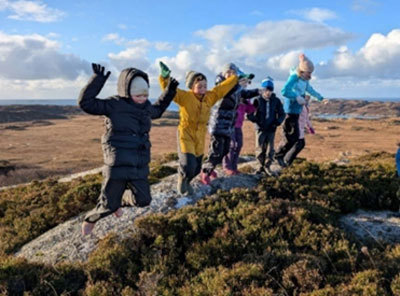
P5–7 pupils visited the rainforest at Tireragan with community partners. They explored the area, identifying trees, lichens and mosses, and particularly enjoyed making the most of the sunshine on Torr Fada.
Marine Science Workshop
Pupils worked with the Scottish Association for Marine Science during a workshop on whales and dolphins. The children were highly engaged and particularly enjoyed comparing the sizes of different sea creatures found locally.
Archaeological Dig
Our P4–7 pupils travelled to Iona to work with the National Trust for Scotland on an archaeological dig at Maol Cottage. This provided a fantastic opportunity to learn more about the history of our local community and explore the wide range of roles within the National Trust. Children learned new skills and experienced what it might be like to work as an archaeologist.
Gàidhlig Heritage and Culture
We had a great day when Trail West joined us for a workshop to learn their song Ar Cànan ’S Ar Ceòl as part of their project with Còisir Ghàidhlig an Eilein Mhuilich (Isle of Mull Gaelic Choir). The day was filled with singing, dancing and lots of fun.
Shinty – Cupa Iomain na h‑Òige
Children competed in the Cupa Iomain na h‑Òige, enjoying a day full of shinty, Gàidhlig, fun and sportsmanship. The highlight of the day was a win for Bunessan in the P1–3 competition.
The cup has been gifted to us by Iomain Cholmcille, enabling the development of a Mull-wide shinty tournament.
Gàidhlig Place Names
Our collaboration with a university expert in Gàidhlig supported the creation of this display, helping children develop a clearer understanding of the derivation of the place names in the areas where they live.
Woodland Signage
Children worked in Tiroran Community Forest alongside the National Trust ranger to develop bilingual signage and a visitor leaflet for the nature trail.
Community Garden
During one of our visits to the Community Garden, children took part in reaping, cleaning, chopping, cooking and, of course, eating! With support from our Community Garden partners, pupils made herbal tea, pesto pasta, soup and cinnamon apples.
Careers Week
As part of our Careers Week activities, pupils visited Isle of Mull Weavers to learn how this local business operates. They discovered that weaving is a fascinating mix of mechanics, mathematics, hard work, inspiration, creativity, trial and error, and a little dose of magic.
Sailing
Working with a local Community Interest Company that specialises in water sports, our P5–7 pupils participated in a block of sailing lessons. These sessions helped children develop confidence on the water while acquiring new sailing skills.
Farm to Fork
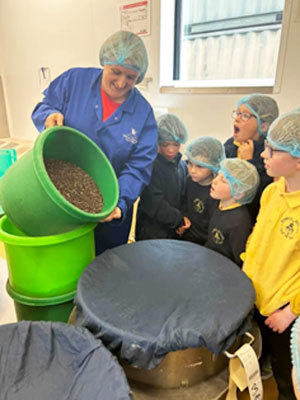
We celebrated the end of our Farm to Fork topic with a whole-school trip to a local organic bakery and local cheese producers. Pupils learned how local businesses operate, explored associated job opportunities and gained an understanding of how the local environment is integral to these industries.
Tidal Arts Project – Artica (Svalbard)
P5–7 pupils collaborated with a Gàidhlig place‑names expert and resident artists, alongside pupils from Iona Primary School, on a project exploring how knowledge can be shared across island environments through visual art, sound and community engagement.
The children enjoyed listening to stories, singing Gàidhlig songs, creating artwork and collecting stones that will be shared with children in Svalbard.