

Approaches to supporting positive relationships and behaviour at Lynburn Primary School
Lynburn Primary School is in Dunfermline, Fife and serves the Abbeyview area within the eastern side of the city. The school is in a recognised area of regeneration, mostly comprising social housing. Over half the children live in Scottish Index of Multiple Deprivation (SIMD) deciles one to three. The school role is 384 and free school meal entitlement is 34%.
The improvement issue
Senior leaders have identified that low engagement in learning is impacting some children’s attendance and progress. A few learners are not ready to engage due to dysregulated behaviours, often linked to negative childhood experiences such as trauma and adversity. There is also a recognised connection between poverty and increased risks to mental and physical health.
Staff have reported spending considerable time managing low-level behaviours, particularly following playground breaks. They also acknowledged a lack of confidence and knowledge in supporting children’s emotional needs and highlighted the need for a deeper understanding of mental health and effective strategies to support wellbeing.
Feedback from parents attending anxiety workshops indicated a desire for more support to build their confidence and ability to help their children. Staff recognised the importance of offering a range of support for families.
Senior leaders are committed to improving mental health and emotional wellbeing for all children and have identified those who may benefit from more tailored support. They are exploring strategies to reduce anxiety and associated behaviours, helping children feel more ready to learn. A holistic, community-based approach has been prioritised to ensure children are supported through strong partnerships with families, carers, and school staff.
What Lynburn Primary did
Strategic approach to wellbeing
Senior leaders developed a strategic plan with staff. The work was led by the Pupil Equity Fund (PEF) principal teacher (PT) and aimed to create a nurturing, inclusive, and trauma-responsive school. Grounded in neuroscience, the approach focused on how the brain develops and responds to distress. The plan focussed on: upskilling staff; providing support for families and providing universal and targeted support for children.
Staff professional learning and support
Staff actively participated in professional learning on trauma, attachment, and wellbeing, including de-escalation techniques. They redesigned classrooms to align with the ‘regulate, relate, reason’ principles, to create calmer spaces that can help reduce children’s anxiety and boost their engagement.
Staff introduced behaviour management strategies such as scripted responses, with matching images, which were used consistently across the school. For example, “Is this a play-do problem (changeable) or a rock problem (out of our control)?” All staff used these scripts when supporting children to regulate their behaviours. Staff also shared the scripts with parents in workshops and through the school’s Family Wellbeing Toolkit booklet. This promoted accountability and compassion while ensuring that blame and shame were eliminated.
Identified teaching staff actively championed staff wellbeing, helped to build resilience and foster a positive work environment. Staff received training in providing peer support and time was protected for these sessions throughout the year. Staff valued opportunities to talk with their peers and share concerns, which supported their own resilience.
Targeted support for children
Staff worked collaboratively to develop proactive management plans to help identify interventions and manage the delivery of targeted support. Progress is reviewed regularly through meetings with children and their parents. Clear targets and support strategies are agreed and monitored.
A few children benefit from access to nurture classrooms. Staffing supported by PEF funding, provided structured and supportive environments to help children to develop emotional regulation, build confidence, and improve their focus.
A few children in P1 took part in structured wellbeing activities in the Lighthouse Classroom. This space offered them opportunities to move in different ways, such as jumping, rolling, pushing, pulling, and moving to a rhythm. These activities use specialised equipment that gives children important feedback from their bodies, helping them understand how their bodies are moving and how they feel. This feedback helped children to feel calm and enhanced their ability to regulate their emotions.
Pupil leadership of universal support
A few children led the promotion of wellbeing, fostering responsibility, peer support, and creating a positive school culture. Staff trained pupil leaders in breathing, tapping, yoga and mindfulness. Roles included:
- ‘Aquarium Ambassadors’ planned and led daily wellbeing sessions.
- ‘Calm Club Workers’ help support emotional regulation in the playground for children who are upset or lonely.
- ‘Peer Mediators’ resolve minor conflicts.
- ‘Emotion Workers’ develop emotional literacy.
Staff noticed positive changes in the children in their classes as result of daily wellbeing sessions and pupil-led support in the playground. They saw better engagement in learning, stronger friendships, and more awareness of emotions.
Parents and carer support
The PEF PT developed workshops to support family wellbeing and emotional literacy. These workshops fostered a safe ethos where parent and carers were encouraged to feel nurtured and supported. They explored concepts such as attachment, containment, emotional regulation, rupture and repair, emotional boundaries and regulate, relate, reason. Parents were guided to develop their own strategies for each concept. These strategies helped to foster positive relationships with their children. Simple displays were created to support parent’s understanding of concepts. Additionally, staff created a family wellbeing toolkit to supplement each workshop. For example, including scripts for parents to use and strategies to support them.
What the sustained impact has been
Staff have created a highly nurturing and inclusive environment, which is supporting children’s readiness to learn. Staff support all children to regulate their emotions and understand what impacts on their emotional wellbeing. These approaches are consistently applied to everyday life. As a result, children’s wellbeing needs are being met, and positive behaviour and relationships are more evident throughout the school.
Children’s benefits:
- Improved mental health and emotional wellbeing: after twelve months of ‘Wellbeing Moments,’ led by Aquarium Ambassadors, 80% of children reported better wellbeing.
- Introduction of a common wellbeing language: staff and children consistently use shared terms and strategies, fostering a supportive culture.
- Reduction in exclusions: exclusions dropped by 50% following the introduction of Lighthouse classroom.
- Readiness to learn: teachers observed that proactive plans based on regulate, relate, reason principles resulted in most identified children seeing increased readiness to learn.
- Enhanced pupil leadership: children in leadership roles show increased confidence and responsibility, with staff noting higher engagement from other children as a result of their peers leading learning.
- Improved self-management skills: all P1 children in nurture groups, including the Lighthouse Classroom, showed measurable gains in emotional regulation and self-management post-neurosequential assessment.
Parents and carers benefits:
- Greater confidence in supporting children’s emotional needs: 100% of workshop attendees reported they had learnt from and enjoyed the sessions.
- Strengthened family relationships: parents reported that workshops had brought families closer together, fostered positive communication and compassionate responses when children are upset or overwhelmed.
- Enhanced peer support and solidarity: parents found comfort in the commonality of their experiences and peer support helped foster a sense of community and understanding that they are not alone.
Staff benefits:
- Integration of neuroscience-based strategies: teachers and support staff surveys indicate all staff have increased in confidence in applying regulate, relate, reason principles in daily interactions.
- Reduced time managing conflict: teachers observed fewer playground disputes, as peer mediators successfully resolved minor conflicts, allowing staff to focus more on learning.
- Decreased stigma around mental health: senior leaders have observed that staff and children now openly acknowledge and respect emotional wellbeing fluctuations.
- Collective commitment: all staff demonstrate a shared commitment to supporting positive relationships and behaviour, observed through consistent practice, shared training, and regular collaboration.
Supporting information
Nurture Rooms
The Lighthouse Classroom is designed for proprioceptive activities with displays to support emotional literacy.
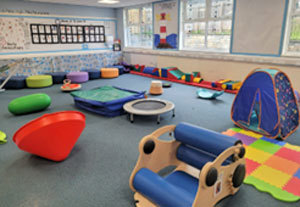
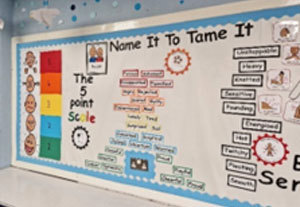
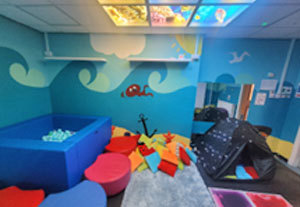
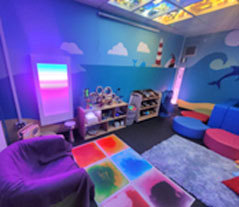
The Dolphin Room – a sensory room that is designed to calm and sooth. There are activities that link to each sense.
Symbols used throughout the school on documentation and displays to act as a visual for each concept. The model underpins how we approach wellbeing and support children with additional and intensive needs.
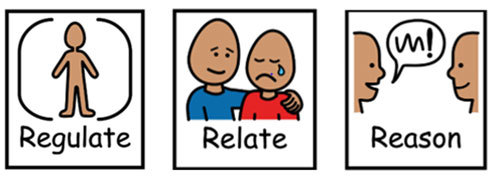
Regulate, Relate, Reason and Restore
Examples of whole school scripting used by staff and pupils in leadership roles. Scripting is restorative and designed to reduce blame and shame and promote accountability and compassion.
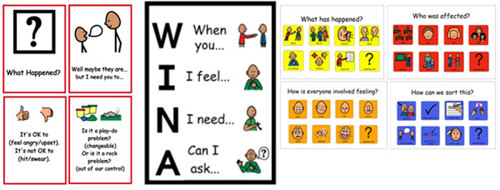
Peer Mediators

Pupil quotes:
“Tapping makes me feel calm, it makes me feel happy.” P3
“It makes me relax.” P7
“I like the breathing. I know it helps me, but I can’t explain it.” P3
“Sometimes I have too much energy and I get angry. I get all my energy out in the Lighthouse, and I feel calmer.” P4
“I like tapping because when I’m stressed, I felt really stressed and I didn’t know why. I came here (nurture classroom) and it calmed my body down. I felt more relaxed. I did it with my class. Of all the strategies, I love this the most.” P7
Parent quotes:
“The workshop has helped me to learn about the tapping method properly, meeting other parents and knowing it’s not just my child, being able to understand how my son is trying to cope with things and how it can come out as behaviour, learning new ways to help and support him.”
“Every week was something new, I have learned that I am not alone, and I have been shown some new tools to use to help my daughter.”
“The workshop has given me ways and means of understanding my child and how best I can support my child's needs. While also recognising how to better understand myself and emotions. Culminating in being a better and more understanding parent. I felt more enabled with hearing and sharing experiences from the group with the right direction. The booklet is a great tactile reference to refer back to and re-read as and when needed.”
“My overall wellbeing has improved significantly most importantly the relationship I have with myself and am learning to be kinder to myself and to others.”
“The relationships with my children have improved”
“I gained how to help my children cope better when there upset and hope to communicate better with them.”
Lynburn Primary School teacher quotes:
- “I feel hugely supported by the whole school. I have been able to have a better work life balance and feel a lot happier. I feel that Lynburn is always a safe environment and can always say if I’m struggling with my work or mental health.”
- “Wellbeing is promoted in an innovative way – not an easy task! Things that are practical are most effective. For example, the water and extra items in the staffroom (like emergency lunches and paracetamol) all directly impact wellbeing.”
- “The staff seem closer, people are more honest about their feelings and there’s a better sense of being kind.”
- “The Wellbeing Toolkit is useful for regulation. How to bring yourself back down to a less agitated state.”
- “The practical aspects of the toolkit are really useful and valuing time to recognise the different types of well-being.”