

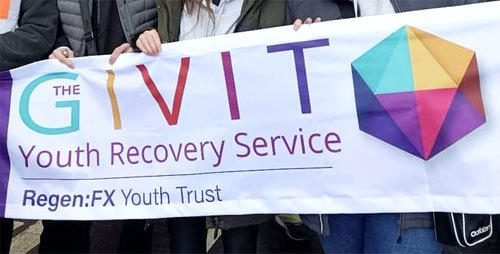
The GIVIT youth recovery service in South Lanarkshire
Regen:FX Youth Trust is a third sector partner represented on South Lanarkshire Council’s Community Learning and Development Partnership. South Lanarkshire Alcohol and Drug Partnership (SLADP) awarded a contract to Regen:FX Youth Trust to develop the first ever Youth Recovery Service in Scotland called ‘The GIVIT’. This service uses innovative approaches to tackle alcohol and substance misuse in 11-25-year-olds. The approach integrates youth work methodologies with Recovery Oriented Systems of Care (ROSC) and cognitive behaviour therapy (CBT) counselling.
The improvement issue
SLADP members recognised the need to tackle alcohol and substance misuse in young people aged 11-25 years. Evidence highlighted the need for a more flexible and assertive outreach approach that focused on early intervention and prevention. The approach involves practitioners proactively seeking out individuals in their own environment or familiar spaces. For example, their home, local community, school or college. The aim is to provide intense support services and engagement with the target group rather than requiring them to attend clinics.
SLADP recognised the need for a new service to help support those young people who are detached from, or struggle to maintain engagement with, mainstream services. This included developing targeted responses to address health inequalities linked to substance use.
There was also a need to develop clearer pathways into treatment and recovery initiatives and wraparound support. Adopting innovative and responsive approaches could contribute towards meeting Medication Assisted Treatment (MAT) standards across South Lanarkshire and help to move young people into more sustainable and visible recovery communities.
What SLADP team did
The GIVIT works towards achieving the following outcomes:
- Increased number of vulnerable young people engaging with treatment services.
- Reduction in ‘did not attend’ rates and unplanned discharges through flexible outreach approach.
- Reduction in the number of children escalating through the children’s hearing system and shifting the balance of care to community outcomes.
- Reduction in drug related deaths in the younger population.
- Establishing a young person’s recovery community with equitable locality spread.
- Increased engagement in recovery initiatives.
- Increase in the number of interventions available to young people around substance use.
- Increase in the number of young people actively engaging with wider community initiatives.
Regen:FX Youth Trust developed The GIVIT, which is a commissioned service to support some of the most vulnerable young people. This includes young people who are care experienced, experiencing homelessness, or involved in the criminal justice system. Regen:FX Youth Trust co-created The GIVIT service with young people that had lived or who were living with drugs or alcohol misuse. A few young people became involved in a Youth Advisory Panel for The GIVIT service.
Referrals to The GIVIT service can be made by professionals, friends and family or self-referral from the young people living in South Lanarkshire:
- Aged 11-25 years.
- Problematic alcohol or substance use.
- Non-engagement with mainstream services.
- Only accessing Medically Assisted Treatment.
- Early and effective intervention (EEI) for 11–16-year-olds.
- Affected by a loved one’s substance use.
The GIVIT service provides innovative ways to engage young people who are at risk. It blends youth work approaches with one-to-one support, cognitive behavioural therapy (CBT) counselling, a full recovery model, and wraparound support for young people. This includes addressing harmful substance misuse by introducing activities, including cold water therapy and alcohol-free raves. The service successfully created a visible Youth Recovery Community, that accesses GIVIT hubs, and partners spaces across South Lanarkshire. This provides young people with access to safe and inclusive spaces where they can receive support and socialise with their peers.
The project is flexible, is open every day of the week, which includes out with traditional opening times. This flexibility reflects the needs of the target group. Youth Navigators, who are employed by Regen:FX Youth Trust, use trauma informed approaches to assist young people into clear pathways to access treatment and recovery initiatives.
An intensive outreach approach is used, which includes provision of services at times, and in locations to suit the needs of young people. This helps Youth Navigators to develop relationships with young people. They also act on referrals to increase engagement with statutory services, which is helping to reduce the number of unattended appointments. The GIVIT service makes effective use of digital technology and text messaging to link with the referring service to carry out joint first visits. This helps to reduce young people's anxiety when meeting new staff and increases successful engagement in the service. The use of digital tools helps young people to see planned recovery community activities, and they can accept or decline invitations to attend. The use of digital tools enables practitioners to adapt activities to meet the needs of young people and cater for the expected number of attendees.
The GIVIT staff work collaboratively with other agencies to ensure that the most appropriate service provider is engaged, and young people are signposted to specialised providers where required. The service offers flexible support with a level of intensity appropriate to a young person’s situation. CBT counsellors within The GIVIT staff team enables rapid access to therapeutic interventions; which helps to reduce clinical waiting times.
What the sustained impact has been
The GIVIT implemented the use of a person-centred evidence-based tool for measuring and supporting change. This highly visual tool enabled young people to see their journey of change and help staff to record the impact of their work. Staff undertake an assessment when they start to work with a young person. This is repeated over the period of support, with an average of 74 days between each assessment. The GIVIT staff complete an initial star assessment with young people within one week of commencing engagement in 79% of cases.
There were significant improvements in the six areas of assessment during the period of 5 Jan 2023 to 4 Jan 2024. Eighty-five percent of young people assessed reported an improvement in at least one area, 74% improved in at least two areas and 67% reported improvement in at least three areas.
The analysis of data showed that cannabis and alcohol were the most widely used substances across all age groups with young people reporting daily and weekend use. However, data showed a significant increase in the use of cocaine amongst young people. The GIVIT staff provided support to individuals who were experiencing nasal tissue damage, even though the substance use had been less than one year. There was an increase in the number of self-referrals to the service from young people experiencing suicidal thoughts, whilst they were withdrawing from cocaine use. As a result, practitioners developed a six-week cocaine workshop that enabled young people participating to improve their understand of the triggers, impacts and reward pathways, and to identify safe activities. This was a collaboration with CBT counsellors, who included grounding techniques to support participants in reducing their stress, anxiety and to recognise triggers.
In the first year, The GIVIT service exceeded targets by 72%. This was due to the higher demand for the service than projected. In response, SLAPD expanded the service to include specialist staff posts. For example, Early and Effective Intervention Navigator, Homeless Youth Transition Navigator, and a Family Support Navigator. Over the last year, The GIVIT service has reached 81% of their engagement target.
In addition, SLADP identified a gap in provision for young people aged from 11 years taking risk around the use of alcohol and/or substances. This included young people who are affected by a loved one’s substance use. The GIVIT service offered to expand their reach by adapting a current service that sat within the wider Regen:fx portfolio of youth services. This service had a proven track record in achieving positive outcomes for young people. The new development is called ‘GIVIT some STREET’ and started in April 2024.
Related link
See how the GIVIT service fits within other local services.
South Lanarkshire Council Community Learning and Development Progress Visit Report 02/07/24
Supporting information

"Coming here and putting the work in has helped me feel like a kid again. Like how I felt before it all turned to crap. I love it. I feel happier and lighter. It's such a mad journey but I love it and want to tell others how I'm feeling." (young person)
“I joined The GIVIT three months ago, since then it has been the most progress I have made in my recovery. I started a few recovery meetings with adults but it wasn’t for me and didn’t make a difference. Then I was introduced to the lovely people here at The GIVIT who I now call my friends. Favourite memory is first day, coming in and seeing everybody and how humble everyone was and so like me. I would like to see as many GIVIT hubs as possible in the near future.” (young person)
“I was introduced to The GIVIT not that long ago but since then I have slowly managed to sort myself out and now applied for college. I definitely feel a lot better.” (young person)
"We decide what The GIVIT should do, including activities and what facilities will look like. My favourite memory of The GIVIT is the recovery residential, I was the oldest there and got to work with the young people and help them.” (member of the youth advisory panel)